显示标签为“AI”的博文。显示所有博文
显示标签为“AI”的博文。显示所有博文

9/13/2018

China's AI super server comes out, providing AI calculations 20 million times per second


New Wisdom AI WORLD 2018 World Artificial Intelligence Summit

Countdown 7 days

Xinzhiyuan will hold the AI ​​WORLD 2018 World Artificial Intelligence Summit at the Beijing National Convention Center on September 20th. MIT Physics Professor, founder of the Future Life Institute and author of Life 3.0, Max Tegmark, will deliver a speech "How We Use AI Instead of being suppressed by it, explore how to face the emergence of AI militarization and killing weapons, welcome to the scene to exchange!


[Xinzhiyuan Guide] On September 12, Inspur Group and IDC Research released the "China AI Computing Power Development Report". The report shows that China's AI investment increased 10 times last year, Beijing's AI computing power lost to Hangzhou, ranking second. At the same time, AI computing faces these four major problems.

The only artificial intelligence conference in the industry centered on "AI Computing" released an important report yesterday.

On September 12th, the abstract version of the “China AI Computational Power Development Report” was officially announced at the 2018 AICC Artificial Intelligence Computing Conference.

This report was published by Inspur Group and IDC. The report is worthy of attention. Beijing's AI computing power ranks second only, Hangzhou is the first; AI investment has increased 10 times last year; biometrics and smart city areas are facing Big chances.

This report aims to provide a comprehensive assessment of China's AI computing power, including the regional distribution of computing power and industry distribution, clearly showing the development trend of China's AI industry, industry status and typical applications, and the AI ​​that will mature in 2025. Typical application scenarios are expected to be worth collecting.


In addition, Inspur is still the world's first AI super server - AGX-5, this server has a computing performance of up to 2 petaflops per second, and can have 16 latest boards high-speed interconnect in 8U space. It is currently one of the most powerful AI computing hosts in the world. The development of the AGX-5 is also a new result of the pursuit of higher research and development effectiveness under the challenge of the surge in computing volume.

The following is a highlight of the "2018 China AI Computing Power Development Report" and the Artificial Intelligence Computing Conference:

AI is still breaking out: investment increased 10 times last year, computing power increased by 230%

The report shows that artificial intelligence began to break out in 2017, thanks to the explosive growth of data volume, the emergence of new machine/depth learning algorithms and the increase in computing power.

The various financing, investment and valuations around AI have also reached a historical peak. In 2017, investment in AI increased by 10 times, computing power increased by 230.7%, and data volume increased by 50%.


The explosive growth of data provides sufficient “nutrition” for artificial intelligence. According to IDC, by 2025, the global data will climb from 20.9ZB in 2017 to 163ZB, and the compound annual growth rate will reach 29%.


As AI investments go up, the demand for AI computing infrastructure is growing rapidly. From 2016 to 2021, both AI investment and computing power showed an upward trend.

Among them, the AI ​​consumer market will grow from 24.31 billion in 2017 to 5.893 billion in 2021; the GPU market will grow from 17% to 5.6449 billion in 2017 to 34.0803 in 2022. One hundred million U.S. dollars.

Looking back at 2017, the annual compound growth rate of AI investment and the compound annual growth rate of computing power have reached the highest point, respectively 414.3% and 230.7%, which is one of the reasons why 2017 is called the Chinese AI first year.

China's AI computing power is uneven: Top10 cities account for half of the eastern part, and Beijing ranks second.


In the development of China's AI computing power, Inspur comprehensively considers the impact of computing power, algorithms, and data on the development of artificial intelligence, focusing on the four main dimensions of investment and supply in the AI ​​field, industry and region, demand and application, potential and trend. And reached the key research conclusions.


First of all, from the perspective of the city, the competition in the investment and computing power of several major cities in China is quite fierce. The top five cities in the development of AI computing power cities are Hangzhou, Beijing, Shenzhen, Shanghai, and Hefei, which are in the first camp of AI computing development. Chengdu, Chongqing, Wuhan, Guangzhou, and Guiyang ranked in the second camp of AI development (in no particular order).

The report shows that in these cities, the mature market environment and good industrial policies have laid a solid foundation for the development of artificial intelligence. In particular, Hangzhou, Beijing and Shenzhen, which are among the top three, have gathered a large number of AI fields. High-tech companies have formed a good atmosphere for AI entrepreneurial innovation.
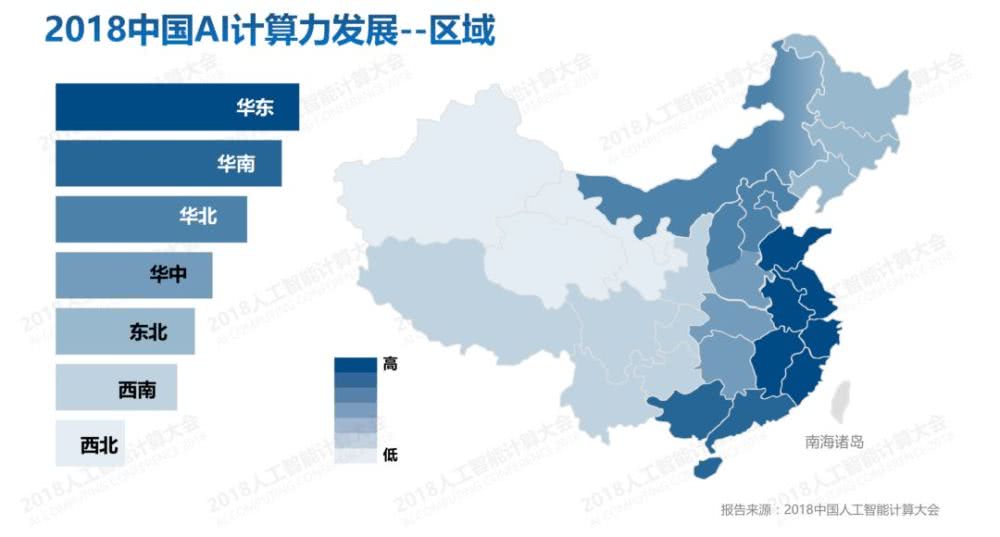

However, from the perspective of regional distribution, East China, South China and North China are in the top three. Overall, the degree of AI development in the eastern region is higher than that in the western region, and the development in the southwest and northwest regions is the lowest.

Business Opportunities for the Next 2 Years: Biometrics and Smart Cities


At present, China's artificial intelligence has been applied in many vertical fields such as the Internet, government, medical and financial. The AI ​​computing TOP industry includes the Internet industry. The application scenarios include search engine and e-commerce user behavior analysis. The government departments are mainly used for government departments. Public safety and public services; the medical industry for disease prediction and diagnosis, credit risk management; the financial industry for knowledge management and generation, online business face recognition, etc.
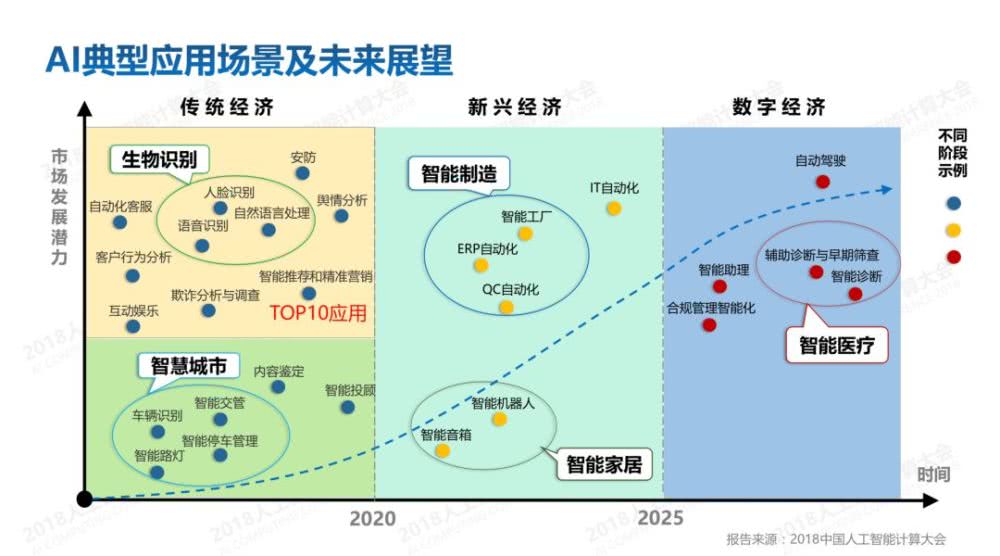

It is expected that in the next 2-3 years, the application of artificial intelligence in biometrics and smart city construction will take the lead in the maturity of commercial applications; in the next 5-10 years, the application of artificial intelligence industry in smart home and industrial manufacturing is expected. It will also gradually step into the fast-growing industrial window.

Liu Jun, general manager of AI & HPC of Inspur Group, explained that in the next five years, we will see that the empowerment from emerging economic AI enters a climbing stage. For example, smart factories and QC automation in intelligent manufacturing will develop rapidly.

AI computing faces four major challenges, heterogeneous computing combined with cloud to solve computing power problems

With the continuous development of the convergence of artificial intelligence and computing, AI computing has also encountered challenges in this process. This report gives advice on the current status of Chinese AI computing power.


At present, China's AI computing development faces four major challenges:

First of all, the development of computing power has not met the demand. The report recommends solving the problem of computing power through the combination of heterogeneous computing and cloud;

Second, the amount of data is still limited. The report pointed out that data sharing + integration can be used to solve this problem;

In addition, AI computing power still has many problems in the process from laboratory to practical application, which requires capacity output and ecological construction as support;

Finally, there is still a gap between the application scenario and the provision of a well-established industry solution. This report points to the need for accurate industry insight and pain analysis if you want to narrow your distance.

Currently the strongest AI super server AGX-5 is released, providing AI calculations of 20 million times per second.

In fact, in the entire AI computing field, from the perspective of the entire industry, many artificial intelligence companies in the past few years have noticed a relatively large change in industrial development. This contains very important technological changes. Liu Jun proposed three important Trend:

In the application development cycle of AI, the industry hopes to shorten the development cycle as much as possible and improve the efficiency of innovation. Therefore, everyone pays more and more attention to AutoML, trying to find the most suitable model through automation, and replace the original consumption with the computing power of the machine. a lot of manpower time;

When AI applications are deployed online, how to save online operating costs has become the focus of more and more attention, and customizable computing has become a technology that everyone pays more attention to;

When AI becomes a pivotal part of the company's entire R&D, more and more customers want to integrate and integrate AI with existing IT technology facilities. This is the change of AI+ cloud.

After sharing the "China AI Computational Power Development Report", Liu Jun clearly stated that these trends are facing the challenge of "how to achieve higher R&D effectiveness in such a rapidly increasing computing environment."

Under this influence, in response to the rise of AutoML, Inspur launched the world's first AI super server, the AGX-5, at the conference.

The AGX-5 is one of the most powerful AI computing hosts in the world. Liu Jun said that it is currently able to have 16 of the latest board high-speed interconnects in a 8U space, providing AI calculations of 20 million times per second. On the strong support, AGX-5 can realize global sharing of 16 GPUs and achieve high-speed interconnection, which greatly improves the performance of AI calculation. When doing some AI recommendation and machine translation, it will be better than other architectures. The performance of 16 GPUs has increased by more than 2.7 times.

Although technological change is one of the major challenges, Liu Jun also said: "We found that the biggest challenge is not technology, technology only completes 10% of the work, and the latter work comes from the entire ecological challenge."

If all the AI-related opportunities we see today are only 10% of the icebergs on the sea, then how to open 90% of the industry market may be the biggest challenge in the entire industry chain. Without sufficient human resources, insufficient partners and a sound system, how will this support such a large-scale transformation of AI? This issue is deeply thought out.

Follow Me
Link:Tenco

                                                             ——END——

8/25/2018

NVIDIA determines the focus of future development: game + artificial intelligence


As a world-renowned graphics card manufacturer, Nvidia recently released its second quarter financial report for FY 2019. The report now shows that compared with the same period last year, the company's sales performance has increased by 40%, has reached 3.12 billion US dollars, net income increased by 89%. %, reaching $1.1 billion, Nvidia's market value of $1.76 per share also exceeded Wall Street experts' valuation of $1.66, an increase of 91% compared to last year.

From the database, game industry, graphics graphics and automotive departments, the company's sales have broken new records, among which the database and game industry accounted for the most important position in these major business units, which is also in line with the company's development. It is expected that in the second quarter, database revenue will increase by 83% in one year and currently account for 24% of total revenue, up from 10.5% two years ago. In this regard, NVIDIA's CFO Colette Kress emphasized that the artificial intelligence AI reasoning system, This technology, which helps AI servers complete voice and image recognition services, has made an outstanding contribution to the department.

She said that NVIDIA will continue to develop the AI ​​reasoning system and expand its database market, and mentioned that the company's recent new AI reasoning software (TensorRT 4) released in the second quarter will help NVIDIA solve the deep learning reasoning workload problem. The CPU can provide up to 190 times the acceleration performance. CEO Huang Renxun also said that NVI has been exploring AI reasoning technology for many years. In the database, AI reasoning software will open up a broader market, although it is not in the NVIDIA database. The biggest business, but its growth potential is huge, and the growth rate will be very fast.


This TensorRT AI inference system can be used to quickly optimize, validate and deploy trained neural networks in hyperscale databases, embedded and automotive GPU platforms, common in computer vision, neural network machine translation, automatic speech recognition, speech synthesis, etc. In application, it can greatly speed up the reasoning of deep learning and reduce the cost of data centers. NVIDIA's leadership team also believes that the total valuation of the business in the market will reach 50 billion US dollars in the future.

The game division accounted for 58% of Nvidia's total revenue. So far, game revenue is the most important performance driver for Nvidia. In the second quarter, the company's game revenue increased by 52% year-on-year. NVIDIA management team said that the reason for the increase in revenue On the one hand, because many schools have strong demand for high-end computer equipment, and on the other hand, they are caused by the fast-growing game market, including notebooks, desktops and game consoles, and the market will continue to be active in the short term. The audience of e-sports games is currently close to 400 million, an increase of 18% compared to the same period last year. The popular games like Fortnite "Fortress Night" have made great contributions.

Kress also mentioned that NVIDIA's recently announced Turing architecture will take the gaming industry to a new level, and said that the Turing architecture is the most important innovation of NVIDIA since the release of CUDA GPU. This new GPU architecture will become The cornerstone of future company development, and CEO Huang Renxun's original words are as follows: "Turing architecture is a re-innovation of computer graphics, this is the first to use ray tracing technology in the environment, create real shadow reflection effect and achieve regional lighting, omnidirectional illumination And GPUs for regional lighting modeling, and these built images will be very refined."


For many years, Nvidia has been in the leading position of graphics processors. The company’s second-quarter sales performance has also led the NVIDIA to stand in the spotlight with the release of the Turing architecture, but even in the face of such strong second-quarter results. NVIDIA still maintains a cautious development attitude, saying that the expected development target for the third quarter should be flat at around 2% floating point, reaching $3.25 billion in revenue, while Wall Street's forecast for NVIDIA in the third quarter is $3.24 billion.

Kress also mentioned that his earnings expectations did not include the bitcoin-induced mining market, but Huang Renxun mentioned that virtual currency has a great impact on the development of NVIDIA's GPU business. He mentioned: "At the beginning of this year, we thought Bitcoin mine The machine market will contribute a lot to the GPU business in the years to come, but now we find that the development potential of this business is not ideal." In general, NVIDIA's future development momentum will continue to rise in the near future, its game in the game. The position of industry and database is almost unmovable. In addition, the company's recently announced Turing architecture graphics card will become a key factor in its market competitiveness.

Follow Me
Link:Tenco

                                                                    ——END——

7/14/2018

The Swedish bank has let AI leave, and it seems that artificial intelligence will also face performance pressure.

If you have been worried that future work may be replaced by artificial intelligence, then this news may make you not afraid

According to the Swedish media DAGENS INDUSTRI, a Swedish online bank, Nordnet, is preparing to “lay off” its own AI employee, Amelia. The most direct reason is that the performance of the AI ​​assistant failed to meet expectations, and the cruelty of the financial industry is evident.

In the summer of last year, Nordnet invited Amelia, the world-renowned AI assistant, to work with normal staff. Its job is to help customers speed up their business, help customers complete their accounts, and improve customer satisfaction. It is reported that Ameila can recognize words and phrases in more than 100 languages.

"But it didn't do both," said Nordnet CEO Peter Dahlgren. "We have brought new attempts to our customers, and the customer's response is OK, but it has not received overwhelming praise, so in the short term we It is possible to invest AI technology in other businesses."

The investment in AI technology has also brought greater costs to Nordnet, according to which Nordnet's 2017 operating profit was SEK 247 million, the lowest since 2012.

The AI ​​assistant Amelia adopted by Nordnet is not a self-developed artificial intelligence assistant, but a product launched in 2017 with the American technology company IPsoft. This veteran service provider has a 20-year history of innovation, taught by New York University. Founded by Chetan Dube, IPsoft's AI system ranked first in the world last year.

Amelia is considered to be one of the best AI systems in the world and is currently used in the medical and financial industries.

Although it suffered a defeat in Nordnet, overall AI technology is still widely optimistic, including Credit Suisse and Swedish SEB Bank also “hiring” IPsoft's Amelia Smart Assistant. Unlike Nordnet's helplessness, SEB is a tribute to Ameila, and SEB has won the AI ​​Industry Award for its performance.

It seems that artificial intelligence also appears to be "unemployed", but like human employees, if AI is facing the "unemployment" dilemma, either its performance is not up to expectations, or it will be stronger and smarter. Replaced by AI technology.


Follow Me
Link:Tenco

                                                       ——END——

7/04/2018

There is no secret in the World Cup: Someone squats in the corner and quietly reads the player's lips.

Halfway through the World Cup, the brutal knockout is about to enter the quarterfinals. Compared to the passion of the players in the field and the enthusiasm of the fans, the off-site reports on each team are also dizzying. One of the most curious, it is probably some conversation between the coach and the players.

For example, the penalty shootouts in Spain and Russia. When the Spanish coach Jero decided to let Cork kick the penalty, Costa expressed disagreement and repeatedly exchanged with Jero, Cork and captain Ramos. However, this is not very useful. Cork still kicked the third penalty and successfully lost the penalty, which led to the end of the World Cup in Spain.

A similar situation occurred when the group match Argentina 1:1 temporarily settled in Nigeria, Sang Baoli went to ask Messi whether to go to Aguero, only to see Messi nodded, then Aguero was replaced.

The problem is, as if we watched the ball in addition to the shouts of the fans on the scene, the most heard is the sound of playing football. The communication between the coaches and the players is only seen by others. How did those TV stations know what they said? Is it an interview in the background?

of course not. In fact, it is very simple to understand what they are saying, that is, the mouth shape. The formal saying is: read lip language.

Does it sound so high?

From "manual era" to AI.

The use of lip language is to help people with hearing impairments to obtain language information and let them live a normal life. In this sense, it works equally well in sign language. But unlike sign language, reading lip language is a very difficult task, and even if you try your best to practice it, you don't necessarily learn something.

Learning lip language first has good eyesight. Legend has it that the British professional lip language cracked Queen Jessica said that she can crack the contents of others by reading the lips 40 meters away.

It is precisely because there are few people in control, and there are not many people in reality. Reading lip language has become a mysterious and tall thing. In this era, we can turn it into a "manual era" of lip language.

In the past two years, the long-term lip language that relies on personal efforts to maintain the status quo suddenly became a fire, and it seems that it has become a simple matter overnight. The root cause of this phenomenon is the development of AI visual recognition technology. Perhaps we can call it the AI era of lip language recognition. For example, in Machine Ji, the robot Eve reads the mouth movements of Nathan and Jiale to identify the content. So, what is the performance of AI recognition lip language in reality?

From a technical point of view, reading lip language is suitable for AI. Through the capture of the continuous movement of the speaker's mouth, and then matching it with the pronunciation of the word, and finally through the correction, the most coordinated sentences of action, pronunciation and semantics are obtained, thus achieving the cracking of the lip language.

For example, in 2016, Deepmind and Oxford University launched the AI lip language recognition system. By training the system for more than 5,000 hours and 11,800 news videos, it achieved a 46.8% recognition accuracy rate in the final video test, compared with 12.4% for humans. This gap can be said to be quite obvious.


What is certain is that, with the continuous improvement of visual recognition technology, lip recognition will soon be transformed from a legendary "secret" into a daily tool that everyone can equip. But is it really easy to turn a lip language into a universal language aid?

Reading lip language is not easy for people, AI is also like

We know that the deep learning of AI is based on a large number of related materials, such as Deepmind training an AI of lip language recognition, the total duration is 5,000 hours, and the recognition success rate is less than 50%. However, for the current identification, this is already a very good data. After all, the top human lip recognition experts have a success rate of more than 10%. So, since lip recognition is so difficult, what problems should AI need to pay attention to when it wants to take it?

First, we must solve the problem of inconsistent mouth shape. The problem of inconsistent mouth is reflected in two aspects.

On the one hand, because of the difference in pitch, not all people will produce the same action when they send the same syllable. This action may be difficult to detect from a human perspective, but from the time of AI that is good at identifying micro-expressions, a slight difference in motion may cause misjudgment. For example, a fool is unclear, and people sound hard, not to mention lip recognition.

On the other hand, the same language may have different pronunciation patterns due to different regions. Then, in identifying the dialect, the troubles encountered by AI are not small.

Second, the tone of AI lip language recognition. Since it is to identify the content of the speech, it is inevitable to involve the tone of the speaker. The same word, the same sentence, may also have different semantics due to the different tone of the speaker. Simply recognizing the speaker's language content will limit the function of lip language recognition. How to unify the speaker's expression, movement, scene and other factors related to expression into lip language recognition is also a problem to be considered.

Third, in many cases we don't need a humanoid robot. We don't have to make lip recognition a know-how. When training, we can carry out special material collection according to the specific scene used. For example, if the subway station automatically sells tickets, it only needs to focus on the training of the site name. This avoids the cumbersome work caused by invalid work in a specific scenario.

More importantly, language is a very large knowledge base. If you want to accurately recognize the lip language in various situations, massive voice and action training will be a time-consuming task.

Although the lip language is small, the potential is large.

There is no doubt that when the lip recognition technology is mature, its application prospects are very optimistic, such as the following aspects.

1. Security field. The home camera function and scene are relatively simple, and generally there will be a microphone for sound collection. However, in a larger number of outdoor monitoring systems, basically only the picture can be seen without sound. This is a big flaw in electronic surveillance. Then, after the introduction of lip language recognition, it is equivalent to technically making a sound. The content of the offender's communication in front of the camera will be captured, and this is likely to become an important clue to solve the case. The British police used Jessica's lip language ability to crack an airport robbery.

2. The field of medical health. The most primitive role of lip language is to help people with hearing impairments to communicate as normal people, but the cost of learning is undoubtedly huge and may take years or even decades. Even if vision and perseverance are not good, they can only communicate with very troublesome sign language. Then, with the help of lip recognition technology, hearing-impaired patients will not have to spend such learning costs and can communicate directly with normal people.

3. Real-time voice conversion is more accurate. Nowadays, whether it is real-time subtitles in smart courts or simultaneous interpretation in international conferences, it basically relies on pure speech recognition. Through the addition of lip language recognition technology, it will change from a simple "listening" to a "seeing" and "listening", which is more in line with the characteristics of human acceptance of language information. Therefore, the application of AI in real-time subtitles, simultaneous interpretation and other scenarios will be more mature.

In addition, using lip language to recognize speech will have a positive impact on the resolution of speech separation. Before the team separated the voice through the comparison of video and voice, lip language can become a point worthy of attention.

4. Promote the construction of multimodal Internet of Things. For example, the voice ticket introduced by the subway is to determine the arrival station and the ticket holder by double recognition of the voice and face of the passenger. Based on this, combining lip language recognition technology with speech recognition will open up a larger imagination for the construction of the Internet of Things. In the home Internet of Things scene, the entrance represented by the smart speaker can not only rely on the voice recognition command, but also add lip language reading to improve the accuracy of recognition. After all, watching people talking and closing their eyes to listen to others is very different for the recipient of the message.

But lip recognition is also a very vigilant technique. After all, nature limits the distance of vocal transmission, just to protect the privacy of individuals. Once the lip language recognition is rampant, everyone may have no more secrets. The first thing to talk about to pout and go home is to pull the curtains and drive the opaque car film... This kind of world may not be willing to wait.

In any case, lip recognition is a worthwhile technology. Although it is still immature, it is necessary to consider many real problems that are likely to have adverse effects in the future. However, when it shows positive meaning to human society, we should not refuse to give it a hug.

Follow Me
Link:Tenco

7/02/2018

Collaborative Intelligence: The Combination of Humans and AI

Both humans and AI have their own advantages, and how companies redesign their business models will be the focus of future development.

Artificial intelligence has been involved in more and more human work, such as disease diagnosis, language conversion and customer service, and the speed of AI improvement is also amazing. Because of this, some people even think that AI will one day Substituting humans has become a major player in the economy.

The result is really like this? Can you avoid it? In fact, the greater impact of AI technology will be to complement and enhance human capabilities, not to replace them.

Many companies have used AI technology in automated processes, but for companies that only use AI to save staff costs, such practices are short-sighted and will not benefit in the long run.

The Harvard Business Review (HBR) conducted a study of 1,500 companies and found that among the companies with the highest performance levels, the work of employees and machines is combined.

That is to say, through the collaborative wisdom of humans and AI, including the leadership, teamwork, creativity and social skills of the former, as well as the corresponding speed, scale expansion and quantitative ability of the latter, the complementary advantages of each other are actively enhanced. It is.

For another example, it is a natural thing for humans to make jokes, but it becomes a tricky problem for machines. For machines, analyzing gigabytes of data is simple, and humans are almost It is impossible to complete.

Now that you know the benefits of human-computer cooperation, how to maximize this advantage becomes the next key point for the company to consider.


Human assisted machine

In this case, humanity will play three decisive roles: training, interpretation and maintenance.

First, they must train the machine to perform certain tasks. Second, explain the results of the task, especially when the results are not intuitive or controversial. Finally, make sure that the machine does not harm humans.

People must let the machine learning algorithm know how to perform the designed work, which requires a lot of test data. In addition, it is important to let the AI ​​system know what is the best form of interaction with humans.

Machine assists humans

In turn, from a machine perspective, its intelligence is helping humans expand their capabilities in three ways.

Specifically, it enhances human cognition; interacts with customers and employees, allowing humans to engage in higher-level work; and acquiring skills to extend human physical mobility.

American computer software company Autodesk's Dreamcatcher AI can provide more imagination for the best designers. GM also cooperates with this company to design a variety of unique and higher-performance auto parts through software.

Another application is from Microsoft's personal virtual assistant Cortana, which can record meetings and send them to participants who are unable to attend.

The virtual assistant Aida used by the Swedish bank SEB is similar. It can establish communication with millions of customers and can detect the tone of the other party. However, in the process of human-computer communication, about 30% of the problems are caused by the machine alone. In this case, Aida will be transferred to the manual service.

In manufacturing, automation equipment is evolving from potentially dangerous and “stupid” industrial machines to intelligent, environmentally sensitive cobots. For example, a cobot arm may handle repetitive actions that require a large amount of weight extraction, and the worker can perform additional tasks that require dexterity or human judgment.

Hyundai used to showcase an exoskeleton robotic device at the auto show that is said to allow workers to work with superhuman endurance and strength.

Redesigning the business

In order to get the most value from AI, companies need to redesign the process. To do this, companies must first identify areas of operation that can be improved.

Next, companies need to develop new solutions in the form of joint creation, the most important thing is to let shareholders know how to cooperate with the AI ​​system to improve operational efficiency. The third step of the company is to expand this scale and maintain a viable solution.

According to the analysis of HBR, there are five main aspects of the company's business processes that need to be improved: flexibility, speed, scale, decision making and personalization. This means that when redesigning a process, consider which one is the core transformation goal, how to use intelligent collaboration to solve the problem, and how to coordinate with other process characteristics changes.

The last point to make is that reimagining a business process involves not only the realization of AI technology, but also the commitment to ensure the development of personnel's “integration skills” so that they can cooperate in human-machine cooperation. Work effectively.

Human-computer interaction requires humans to use different new methods, and at the same time, make new ideas. However, at present, only a very small number of companies have begun to redesign their business processes in order to optimize human-machine cooperation.

But one thing is clear. Organizations that use AI technology only to replace employees will eventually miss most of the benefits they bring. Those who can become industry leaders will be those who know how to apply and transform AI technology. A company with the same level of importance as employees and machines.

Follow Me
Link:Tenco

Robot shopping guide wins over real person shopping guide by nearly 90% of users welcome

To the person that loves shopping, a good guide is bought be like close close small boudoir honey, let a person be like mu chun feng, enjo...